


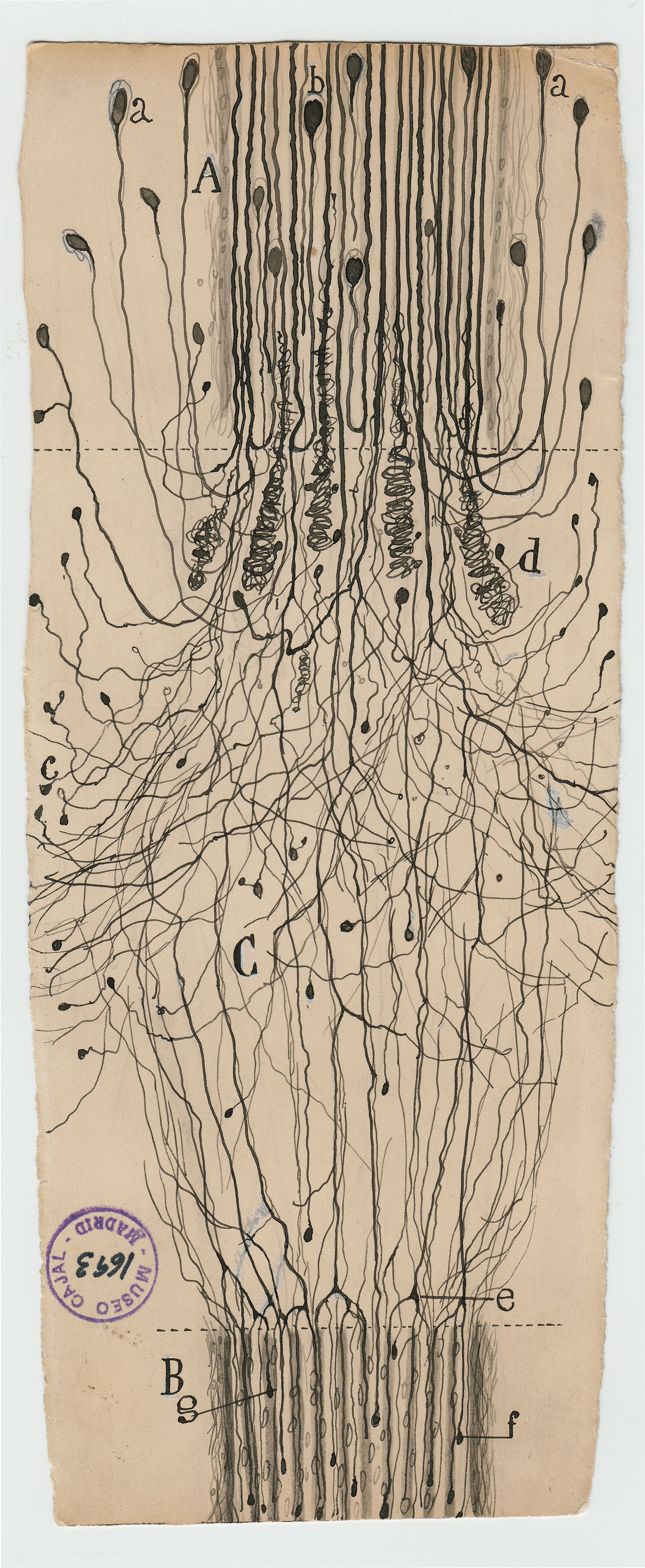
Cajal's 1913 drawing of a cleanly severed nerve, the visual echo of every dismissal conversation: an irrevocable cut, never a gradient.
↳ SOURCEIn a conversation with the HR director of a large retail company, we heard the same pattern we keep seeing in the field: termination meetings get planned as procedural notifications, but inside the first few minutes they slide into defensiveness, anger, silence, or a meeting cut short and pushed to the next day. That is a field observation, not evidence, and we share it only to point at where the problem begins. What is more interesting is that the academic literature has been measuring and naming this same pattern for decades.
Wood and Karau (2009, Journal of Business Ethics) show that the practices used during a termination interview directly affect how employees perceive respect and empathy, how angry they become, whether they file a complaint, and how likely they are to take legal action. Being escorted out in full view of colleagues produced the highest measured anger levels in their study.
This is about more than being "kind" in the delivery. Bies, Martin and Brockner (1993) surveyed 147 skilled employees who had been notified of layoffs, and found that perceived procedural fairness was the single largest factor shaping post-notification organizational citizenship behavior. Adequacy of explanation and dignified treatment were the two building blocks of that fairness perception. Wanberg, Gavin and Bunce (1999, Personnel Psychology) reached a similar conclusion in a longitudinal study: the adequacy of the layoff explanation, the correctability of the process, and the severance package jointly predicted fairness judgments, willingness to endorse the former employer, desire to take the employer to court, and willingness to commit to a future employer.
Richter and colleagues (2018) extended this with two scenario experiments showing that respectful treatment increased both interpersonal and procedural fairness perceptions, and reduced negative attitudes toward the employer. Employees also preferred to receive the notification and explanation from their direct supervisor rather than an external consultant.
The market-survey numbers point in the same direction. Bravely's Understanding the Conversation Gap report finds that 70% of employees avoid difficult conversations with bosses, peers, or direct reports, and 53% manage toxic situations by ignoring them. The VitalSmarts / Crucial Learning Costly Conversations survey of 1,025 people reports that 72% say peers who fail to pull their weight are not addressed effectively, and 68% say disrespectful behavior goes unaddressed; a single failed conversation is estimated to cost an average of $7,500 and more than seven working days. Those last two are commercial surveys, not academic studies, so the precise figures carry less weight, but the magnitudes line up with the academic findings.
Termination is a hard enough moment on its own. Done badly, it can trigger all three of HR litigation risk, reputation damage, and long-term trauma for everyone in the room at once. And the pattern is not specific to termination. Performance reviews, critical feedback, salary conversations, team reorgs: of the dozens of these conversations a manager runs every year, almost none are backed by any systematic preparation.
Why isn't there preparation?
Three structural reasons.
1. Conversation doesn't feel learnable.
Math is learnable, coding is learnable, accounting is learnable. But "facing an employee who starts crying" doesn't feel like a learnable skill. It feels like a "you'll figure it out" category, and every skill in that category performs terribly the first time it is actually used. Yet Richter and colleagues (2016, Journal of Applied Psychology) show that structured bad-news training makes managers run more formal, fairer termination meetings, and reduces employees' negative reactions through fairness perceptions. The skill is learnable. What most companies lack is the systematic training.
2. Role-play has a bad reputation.
A common reaction we hear in the field: when "difficult conversation training" is proposed, many managers default to the memory of a workshop they attended years ago. A scripted exercise across the table from another manager, low realism, socially awkward, and no measurable outcome at the end. That memory is the practical source of role-play's bad reputation, and it matches our field observation of how this training tends to get run.
But the research doesn't say role-play is bad; it says poorly designed role-play is bad. Pilnick and colleagues (2018, BMC Medical Education) note that role-play and simulated interaction in communication skills training have been criticized for not fully reflecting real-life interactions, while also pointing out their value: learners have to think in real time, receive feedback, and watch others approach the same task.
Chernikova and colleagues (2020, Review of Educational Research) provide a meta-analysis of 145 empirical studies. Simulation-based learning produced a large positive effect on complex skills (g = 0.85), and technology support and scaffolding meaningfully increased the learning effect. The implication is that simulation works or fails on its design, not its format. Bosse and colleagues (2010) compared peer role-play with standardized patients in a study of 69 students: both formats received high acceptance and realism scores, but the standardized patient group rated the experience more "worthwhile" (RP 5.17, SP 5.50, p < .003). Peer role-play is not always doomed, but a more consistent and realistic counterpart materially improves the outcome.
The deeper failure mode of traditional role-play is psychological safety. Kolbe and colleagues (2020, BMJ Simulation & Technology Enhanced Learning) describe how, in simulation and debriefing environments, learners can experience fear, anxiety and embarrassment when they make mistakes, ask for help, or seek feedback, and how this leads to withdrawal, defensiveness and face-saving behavior. Forcing managers to perform in front of other managers often pushes them toward performance rather than genuine practice.
3. Real-cadence practice is operationally impossible.
Even if you wanted managers to practice performance conversations once a week, and there is no such thing as learning without repetition, you'd need a partner who would respond in real time, stay in character, and hold the right emotional tone. If you have 1,000 managers, you need 1,000 partners or 1,000 slots, which no budget can carry.
Why human relationships matter more in the AI era
As AI takes on more of the everyday information work managers used to do, what is left is precisely the "human side": explaining a decision, reading emotion, holding a team together in a crisis, delivering a performance warning, preserving respect at the moment of separation. These are the most automation-resistant pieces of management, and they are also the pieces managers practice least.
The World Economic Forum's Future of Jobs reports (2023, 2025) consistently list analytical thinking alongside empathy and active listening, leadership and social influence, motivation, and self-awareness as the skills rising fastest in importance over the next five years. The labor market is pricing human skills up. Yet on the manager side, structured training in those skills is largely absent.
Brynjolfsson, Li and Raymond's (2023) study of generative AI in a large customer-support setting reported substantial productivity gains, with the largest gains concentrated among less experienced workers. That is one specific deployment, so we wouldn't read it as a universal law, but the direction matches other augmentation studies: AI is more useful as a multiplier on human judgment than as a replacement for it.
This creates a paradox. The more capable AI gets, the heavier the weight on each one-on-one conversation between a manager and an employee, because:
- Routine communication, reporting, planning and status updates shift to AI.
- What remains is emotionally dense: performance, crisis, feedback, exit.
- Failure in those conversations has disproportionate cost: retention, reputation, and litigation risk.
A manager no longer lives in a world where 20 small daily interactions can absorb the cost of half of them going poorly. The few human conversations that remain have to be high quality every time, and that requires preparation and practice that is realistic, measurable, and repeatable.
Seeing which sub-skill breaks, and when
A difficult conversation isn't one skill. It is at least four distinct components:
- Opening. Saying what the conversation is about, clearly and quickly. Most managers circle here, softening the real topic behind a mask of friendliness. The other side doesn't know what is happening; their defense activates before the conversation even begins.
- Acknowledgment. Being able to summarize the other person's story. "I understand you're feeling X right now," without the cliché. When this sentence lands at the right moment, it changes the entire trajectory of the conversation.
- Pressure under clarity. Saying something hard without being accusatory. One of the rarest skills. Saying "Your performance fell below target last quarter" while holding tone, without hedging, without excuses.
- Closing. Ending with alignment, on-record, and a defined next step. This is where most conversations fall apart: the other side leaves thinking "so what happens now?" and 48 hours later the grievance process begins.
A real training system should be able to measure these four components separately. Not "good conversation / bad conversation," but "clear opening, weak acknowledgment, collapsed under pressure, no closing." That level of feedback requires either a human who transcribed the conversation or a good-enough AI model doing the evaluation.
Where simulation differs from traditional role-play
Traditional role-play fails in three places:
- Partner effect. The other manager running the role-play is often unfamiliar with the scenario, which means they can't deliver the role's emotional response convincingly. The "performance" drops.
- Observer effect. People behave differently when watched. They don't run the conversation they would actually have; they run the conversation they want to be seen having.
- No repetition. A workshop once a year has about the same behavioral half-life as a one-month vacation.
AI-based simulation addresses all three:
- The counterpart is consistent and emotionally calibrated. The AI's anger or panic doesn't linger after the session ends.
- It happens in private, without observers. The manager genuinely struggles, tries, fails, tries again.
- Cost and speed enable cadence. Fifteen to twenty minutes a week, year-round.
Which conversations should you prepare for first?
It depends on your real distribution. But in most mid-to-large organizations, three of the top five are consistent:
- Performance conversations. Especially the one with an underperformer. These are the most frequent and the worst-run.
- Termination / exit conversations. The highest risk you carry, both legally and emotionally.
- Conflict resolution between team members. Mediation as a third party. Managers typically receive no training for this at all.
The next two typically come out as salary/promotion denial conversations and safety/ethics investigation conversations.
The indicators worth measuring
You can't measure whether difficult-conversation training worked with "training completion rate." The real indicators:
- Legal challenge rate on termination conversations
- Voluntary exit rate after performance reviews (especially among those flagged as low performers)
- Volume of "my manager talked to me like this" complaints to the HR line
- Manager's self-reported "do I feel prepared going into this conversation" subjective score
Tracking these four over time tells you whether the training design is actually changing behavior, far better than a single "completion" number does. Prepared managers run different conversations than unprepared ones, and the person on the other side of the room can feel it.
Difficult conversations are a small portion of a manager's job, but the most expensive one. Preparation for them, until now, has been a three-hour workshop once a year. That wasn't enough, and won't be. In the coming years, difficult-conversation preparation will be part of the standard manager infrastructure. The question is who builds it first.
EVRE's AI role play simulation does exactly this: it gives every manager a private space to rehearse terminations, performance reviews, and salary conversations before they're standing in the room.