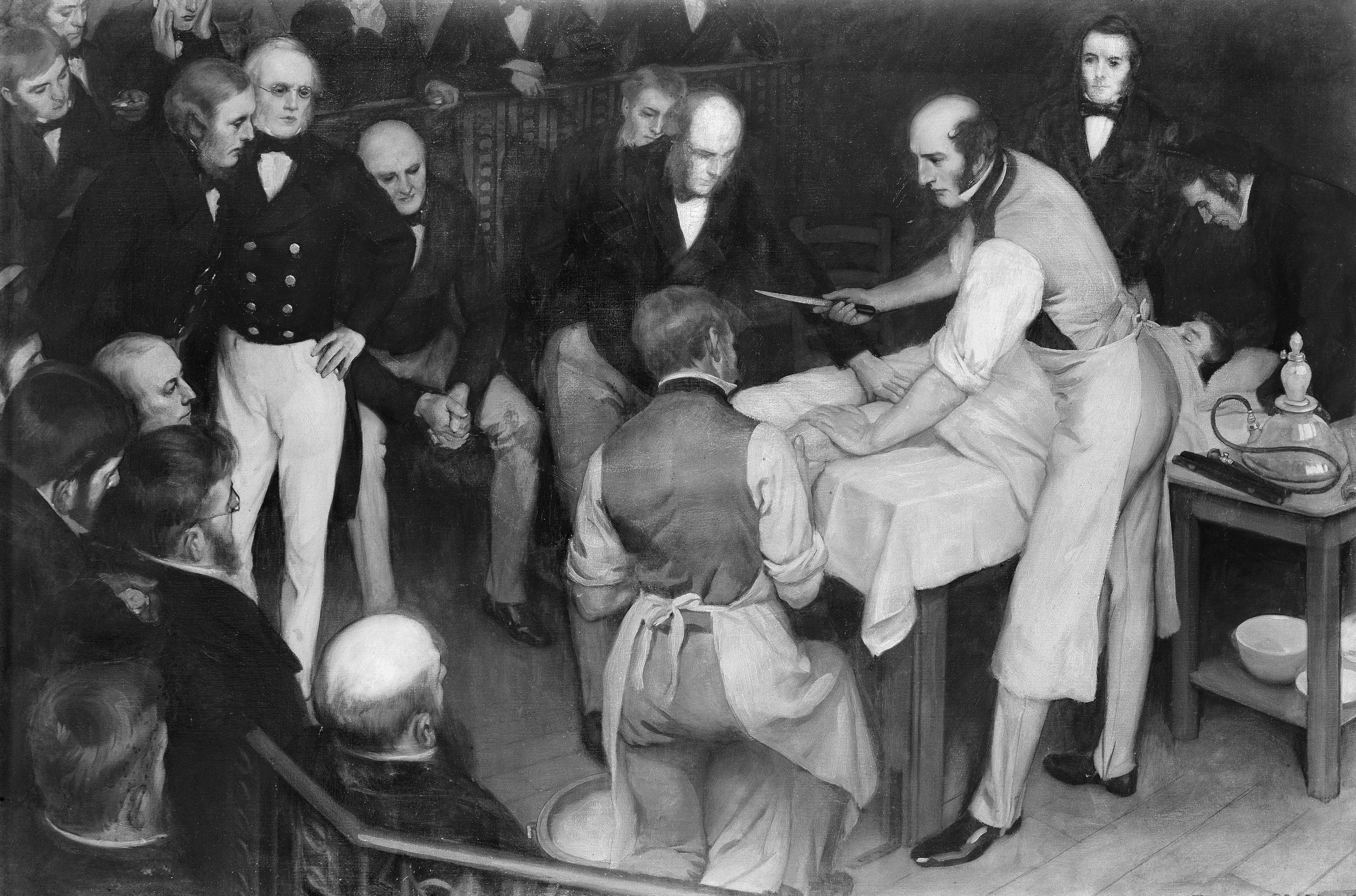



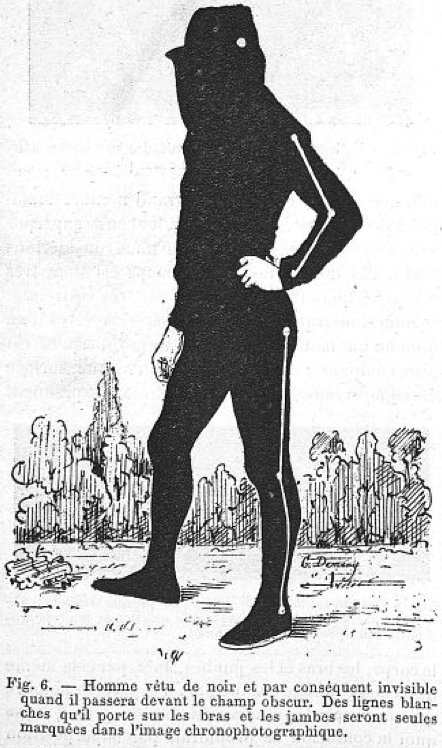
Marey measured a single person's movement by sampling it again and again across time. One frame is a pose; the sequence is the behavior. A team's capability reads the same way, one session at a time.
↳ SOURCEEvery AI roleplay demo ends the same way: a score screen. A number out of 100, a few strengths, a few things to work on, a button to try again. It is the moment the whole session builds toward, and it is also where most tools quietly stop being useful to an organization. The score answers a question about one person in one conversation. The question a company is actually asking is larger and slower: is my team getting better at the conversations that cost us money when they go wrong, and how would I know?
That gap is the subject of this piece. A score is a data point. What turns a pile of data points into something a manager can act on is the system around them: how sessions accumulate into a pattern, how the pattern surfaces where attention is needed, and how you check months later whether anything actually moved. The demo shows you the score. The product, for an organization, is everything that happens after it.
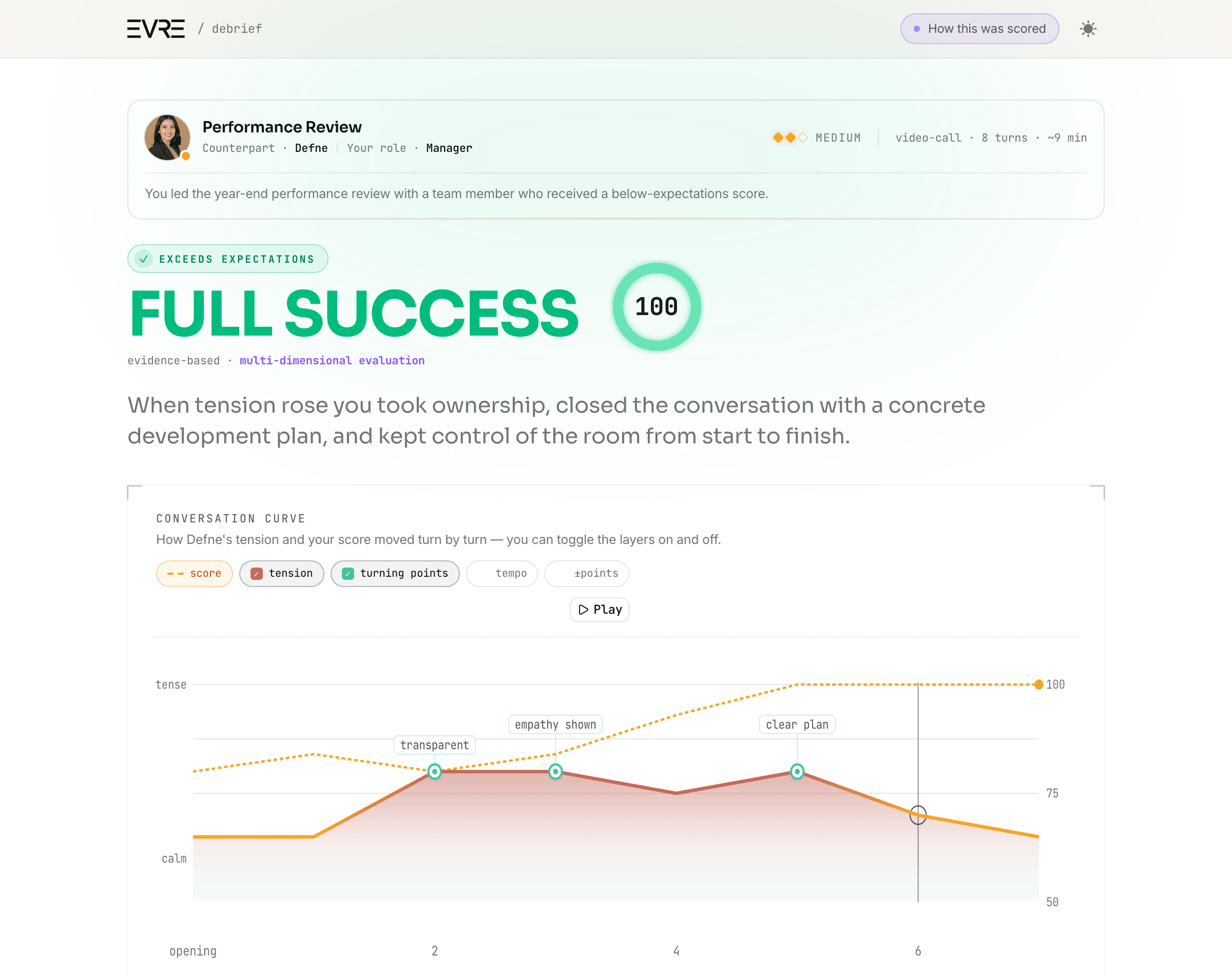
One score is a reading. A team system is the instrument.
A single session tells you how one person handled one moment. The value compounds only when many sessions are read together, over time, against the work that actually happens at your company.
A score screen lights up one figure. A manager's real question is about the other thirty-nine, and about this one next quarter.
What a single score can and cannot tell you
Take any one score at face value and you are trusting a single observation of a noisy thing. A rep who scored 61 on a difficult renewal call might have been distracted, might have drawn a harder persona, might simply have had an off ten minutes. None of that makes the score wrong. It makes it thin.
This is an old finding in measurement, not a new complaint about AI. Epstein's (1979, Journal of Personality and Social Psychology) work on the stability of behavior showed that any single observation of a person is dominated by the noise of that one occasion, and that a stable, trustworthy signal appears only when you aggregate across several occasions. One session is an anecdote about a person. Six sessions across three scenarios start to be evidence. The implication for training is direct: the interesting object is never the single score, it is the trend and the spread underneath it.
So the first thing an organization needs from a roleplay tool is not a better number. It is a place where numbers accumulate into a shape.
This does not mean every trend should be trusted the moment it appears. Early scores are provisional. A signal becomes useful only after repeated sessions, comparable scenarios, and behavior-level evidence a manager can inspect. The point is not to pretend the measurement is perfect; it is to stop treating a single score as if it were enough.
From evidence to pattern: reading a team's behavior
Once sessions accumulate, a team stops looking like a leaderboard and starts looking like a profile. Some behaviors are strong across almost everyone. Others are a shared soft spot that shows up again and again, in different people, on the same kind of moment. That pattern is far more actionable than any individual's rank, because it tells you where a single well-placed intervention would help the most people.
The trick is to keep the pattern anchored to observable behavior rather than a vague impression. Smith and Kendall's (1963, Journal of Applied Psychology) work on behaviorally anchored rating scales made the case decades ago: a rating earns its keep only when it points to a specific, observable thing someone did, not to a general sense of how they came across. EVRE keeps that discipline at the team level. Instead of one blended number per person, sessions roll up into named behavioral factors, each tied back to moments a judge can quote.
Steady across the team. Reps stay calm and specific when the other side gets difficult.
Sequencing is solid. Closes slip when a scenario runs long or branches twice.
The team's clearest gap. Escalation thresholds get missed here more than anywhere else.
Read one level deeper and the same team becomes a set of behavioral signatures: recurring strengths, recurring gaps, and the situations where each pattern appears. The point is not to rank people. It is to see which behaviors repeat, where they break, and which next practice would move the team fastest.
Behavioral Signatures
2 members with a blocking marker
total sessions 85
Read that way, the finding is not "the team averages 64." It is "procedural handling is where this team loses conversations, and it is losing them at the escalation threshold." One is a grade. The other is an instruction.
The trackable loop, not the one-off session
The reason a score screen feels like an ending is that, for a single learner in a single session, it is one. The organizational value comes from closing it into a loop: a session produces behavioral evidence, the evidence surfaces a gap, the gap drives a specific next assignment, and the next session re-measures the same behavior under slightly different pressure. That loop is the actual product. Everything else is instrumentation for it.
This is also why "did they finish the training" is the wrong question. Ericsson, Krampe and Tesch-Römer's (1993, Psychological Review) work on deliberate practice is unambiguous that improvement comes from repeated, feedback-driven attempts aimed at a specific weakness, not from exposure or completion. A trackable system is what makes deliberate practice possible at the scale of a team: it remembers what each person struggled with last time and points the next repetition at exactly that.
None of this treats the sessions themselves as weak. For simulation-based learning, the evidence base is strong, especially when the simulation is designed with scaffolding around it. Chernikova et al. (2020, Review of Educational Research), pooling 145 studies, found a large overall effect for simulation-based learning (g = 0.85). The same review is just as clear that the gains come from the scaffolding and design around the simulation, not from the simulation on its own. An earlier meta-analysis by Sitzmann (2011) reached the same conclusion for computer-based simulation games: trainees gained most when the format demanded active practice rather than passive exposure. The loop is that scaffolding, at the scale of a team. A useful recent framework in AI research points in the same direction: Yang et al. (2024) describe LLM-based social-skill training as an "AI partner, AI mentor" split, one system to practice against and another to give feedback. A trackable team system is what turns that pairing from a single good session into a curriculum. A framework like this points the direction; what turns it into an evidence trail is what EVRE is built to supply: repeated use, behavior-level signal, and transfer checks a manager can act on.
Here is what that loop looks like as a live surface rather than a description. Each point is one session's behavioral trace against the team's baseline band; the drops are where a conversation went wrong, and the run recovers as the same behavior is practiced again.
Performance Flow
Session-by-session behavioral trace — band: team baseline range (avg ± σ)
What a manager can finally see, and do
The difference between a training tool and a training system shows up on the manager's side. When sessions accumulate against named behaviors, a manager stops guessing and starts reading. In EVRE this lives across four surfaces a manager moves through in order, Overview, Performance, Behavioral, and Action, and each one is unglamorous and specific on purpose:
- A view of which behaviors are strong and which are the team's shared gap, quarter over quarter, rather than a wall of individual scores.
- An at-risk signal that flags the people whose trend is sliding before it shows up in a real customer conversation.
- A record of coverage: which scenarios a team has actually practiced, and which high-stakes ones nobody has touched.
- An improvement delta that compares a cohort against itself over time, so "getting better" is a measured claim and not a feeling.
None of that is exotic analytics. It is the difference between a manager who can say "we are weakest at escalation and it is improving since March" and a manager who can only say "people did the training." The first claim can be managed. The second only says that training happened.
Illustrative figure. Six of forty reps show a sliding procedural trend this month, which is a short, specific coaching list rather than a company-wide memo.
The fourth surface is where reading turns into doing. A gap the analytics surfaced becomes a concrete scenario assigned to a name on the roster rather than a line in a meeting, so measurement becomes a next move instead of a memo.
In practice this is mundane. If a team repeatedly misses the same escalation threshold in renewal calls, the next move is not another broad communication module. It is a short scenario built around that exact threshold, assigned to the people whose traces show the gap, then measured again against the same behavior.
The choices behind the surfaces
Three deliberate choices shape how those four surfaces read, and they are where the philosophy actually sits, not in the feature list.
The first is that color is treated as a scarce signal, not decoration. Improving cohorts read in a calm teal and genuine risk in a muted clay, but amber is held back as a rare attention tick rather than a global accent. A surface that lights up everywhere teaches people to look at nothing, so attention is rationed on purpose: when amber appears, it is meant to earn the glance.
The second is that the language stays developmental. The lowest band reads "needs development," not "failing." It is a small wording choice with a large downstream effect, because the surface is built to aim coaching rather than hand down verdicts, and the words a manager reads set the tone of the conversation that follows.
The third is that the analytics point at behaviors and cohorts, not a ranked list of names. This is the same constraint the next section reaches from the ethics side, arrived at here from the design side: the moment a team surface becomes a leaderboard, the practice underneath it stops being safe, and the measurement quietly begins to corrode the thing it was built to improve.
Measuring that it worked, not that it happened
It is not a solved problem in practice. LinkedIn's 2025 Workplace Learning Report still shows how hard it is for teams to tie development programs to business outcomes; many fall back on proxy measures like engagement, retention, and completion rather than direct behavioral evidence. The oldest question in training evaluation is whether the thing you paid for changed behavior on the job. Kirkpatrick and Kirkpatrick's (2006) four levels have drawn that line for decades: reaction and learning are easy to capture, but behavior and results are the levels that actually justify the budget, and they are the ones most tools skip because they are hard. A system that re-measures the same behavior over time is a practical bridge toward Level 3 evidence, especially when managers connect the simulation signal to what happens on the floor. You are not asking people whether they liked the session. You are watching whether the behavior they practiced shows up more reliably when it is re-tested, and whether managers can connect that signal to real work.
Transfer research adds the necessary caution. Baldwin and Ford (1988) and Blume et al. (2010, Journal of Management) both find that whether a skill carries back to the job depends jointly on the training, the person, and the work environment, none of them alone. A 2025 scoping review by Hamzah et al. (European Journal of Work and Organizational Psychology) sharpened that point: after screening thousands of studies it reduced transfer to capability, opportunity, and motivation acting together, and it explicitly challenges the comfortable assumption that better training design on its own will fix the transfer problem. That is the argument for a system rather than a session. Capability comes from the practice; opportunity and motivation live in what the manager does next, and those are exactly what the loop makes visible and coachable. No measurement turns practice into on-the-job transfer by itself — a manager closes that last step. What the loop guarantees is that the manager is acting on a signal, not a hope: when the behavior is reinforced on the floor, there is a reading to confirm it worked.
A completion rate says a session happened. A behavior trend that moves over repeated, scenario-matched practice is stronger evidence: it shows the practiced behavior actually changing, and hands a manager the signal to reinforce and confirm it on the floor.
Delta = composite score change vs. previous period
Trackability without turning into surveillance
There is a real failure mode here, and it is worth naming plainly. The moment behavior becomes measurable at the team level, it can curdle into a monitoring tool, and the fastest way to kill a practice environment is to make people feel watched and ranked inside it. Edmondson's (1999, Administrative Science Quarterly) research on psychological safety is direct about the mechanism: people only take the interpersonal risks that learning requires when they believe the environment is safe to be wrong in. A scoreboard pointed at individuals quietly removes that safety.
The design answer is to keep the analytics pointed at behaviors and cohorts rather than at a punitive individual leaderboard, and to use the signal to aim coaching, not to rank people. Practice has to stay a place where getting it wrong is the point. We wrote about that balance in more depth in psychological safety in simulation; it is the constraint the rest of the system has to respect.
The whole loop, in one moving picture. Scroll through it, and move your cursor across the trace to read what each point is.
One conversation becomes one behavioral trace. The dips are where it went wrong.
session #14 · 12 turns · score 74
The trace resolves into a behavioral signature — its recurring strengths and gaps.
8 strong · 7 watch · 3 blockers
One signature joins the others. The pattern is the team's, not one person's rank.
10 members · avg 67 · 1 at risk
Traces spread across time against a baseline. Getting better becomes a measured claim.
avg 68 ± 9 · Δ +2.2 / 30 days
One trace crosses the risk line. Attention is scarce, so the signal earns a next rep.
at risk → assign 1 rep → next session
The move loops back to a new session, on a higher baseline. The rehearsal repeats.
a new session, on a higher baseline
The short version
A score screen is the result of one rehearsal. It is genuinely useful to the person who just finished, and it is nearly meaningless to the organization on its own. What an organization is buying, if it is buying the right thing, is the system that turns a stream of rehearsals into a readable trend: named behaviors instead of blended numbers, a loop that points the next repetition at the last gap, and a way to check months later that the behavior actually moved. If a tool can only show you the score, it has shown you the least interesting part of what it does. Do not stop at the debrief. Ask whether the same behaviors are moving across repeated sessions, comparable scenarios, and real managerial follow-up.